Showing posts with label lgbtq. Show all posts

Tuesday, June 14, 2016

A sound of sheer silence: a commentary on Elijah, Legion, and Pulse


After the fire, there was a sound of sheer silence.
After the hail of bullets, the murderous flash of bullet light, the thunder of bodies against the floor.
After the earthquake of hope and joy and life torn from lives.
After the ringing and ringing and ringing and ringing of cell phones as friends and family tried to reach those who were no longer reachable.
A sound of sheer silence, and Elijah the prophet cowering in the cave of a nightclub bathroom.

Why are you here, Elijah?, the Lord said, as if the Lord did not know.
As if the Lord had not mourned every time a servant was slaughtered.
As if the Lord had not charged the last remaining prophet with destroying the gods who offered fertility in exchange for blood and violence and death.
As if the Lord had not heard the proclamation of Jezebel: may those gods do whatever they like to me if I do not tear your life from you.
As if the Lord God had not come down from heaven in a flaming and magnificent burst to proclaim that whatever might try to drown it, freedom and life and freedom and life and freedom and life would fight through.

When the Gerasenes, Gentiles who knew not of the God of Israel, arrived at the tombs, they found the man dressed and completely sane,
and the pig-herders said:  This Jesus cast the legion of demons out.
And the people said:  Who is this Jesus, this Jewish rabbi?
And the people said:  Who is this God which he proclaims?
And the people said:  This man has been so violent that leg irons and chains could not hold him.
And the people said:  This man has been so dangerous that we have let him live among bones and graves to protect ourselves.
And the people said:  This church has been so violent that it has broken our bodies and hearts and told us to be grateful that God might spare us from how we were made.
And the people said:  This church has been so dangerous that we have watched it work itself into a frenzy among dead bones, and we have let it go, in the hope we might be safe.
And the people said:  You are asking us to welcome home a man and a church who has tried to destroy us.
And Jesus left, but left the man behind, to live into the story of what God has done.

In the sound of sheer silence, the church began to speak, and said:
We mourn you!
We mourn you!
We mourn you!
As if the church had not been demon-possessed.
As if the church had not tried to tear Elijah limb from limb.
As if the church was not complicit in the wind and the fire and the earthquake.
As if the church had not seen devastation and demonization, death threats and suicide, the continual murders of trans women of color -- and responded with sheer silence.
As if the church had not beaten and broken the lesbian and gay and bisexual and transgender and queer children of God and stood over their bodies to mockingly say:  Where is your God now?

The church proclaims that its demons are gone, but dead bodies lie around it.

Meanwhile, the messenger of God finds Elijah.
Get up and eat, the angel said,
and spread a simple table:  a jar of water and a hot bit of flatbread.
Not much.  But enough.
Enough to take us back through the wilderness.
Enough to find each other,
to fight for life amid proclamations of death.
To fill the sound of sheer silence
with the powerful resurgence of ourselves.

They tried to bury us.
They didn’t know we were seeds.


---

( The last lines are from Dinos Christianopoulos, a Greek 20th century poet and gay man.  The lines were adopted and used often in the Zapatista movement, a Mexican revolution for social and agrarian reforms in the 1990s. 

Image by Oscar Keys through Unsplash. )

Friday, June 26, 2015

Finally: or, the day Isaiah promised


Finally.

Finally, finally, finally.

Finally!

We are laughing, we are crying, we are singing, we are dancing in the streets.  It is Pride weekend and we finally, finally, finally have won marriage equality for same-gender relationships in every state in America.

This is a day centuries in waiting.  This is a day I wasn’t sure I’d see in my lifetime, and here it is.  The exhale of a million long-held breaths is like the sound of the Holy Spirit.  

This is the day the prophet Isaiah promised, telling those with no family to sing as if they had a hundred children, offering love and redemption to those who had too long carried fear, shame, discouragement, and disgrace.

Finally! 

We will celebrate well this weekend.

Yet many voices remind us that there is much more work to be done.  Jennicet GutiĆ©rrez’s interruption of President Obama’s LGBT reception has re-drawn attention to the oppression of trans women of color who are imprisoned or detained in American cells.  Nine trans women of color have been murdered in 2015 alone.  LGBT children and teens still comprise 40% of the homeless youth population, many cast out from hateful families and shunned by friends and churches.  Thousands of open or closeted LGBT people will hear today, from family and friends and coworkers and peers and even church leaders, that the Supreme Court’s decision is one more American backslide into perdition.

Nation-wide rights to marriage ends one part of legal discrimination; it does not end the cultural, societal, religious, and interpersonal hatred many of us face each day.  

So the question is:  what do we do now?  A person of faith might say:  Where is God calling us now?

Today’s ruling has only legal effect; it changes nothing about religious practices of barring same-gender couples from marriage.  But there is something glorious and godly in it yet.  The good news of the long arc of history that bends toward justice is the good news of a just and loving God.

This is the day the prophet Isaiah promised.  This is the day of rebuilding.

We have been torn down.  We, the LGBT community, have been gripped and pulled and ripped apart by those who opposed us, by strangers and family alike, who claimed we had no place in the law or in the house of God or even the world.  We have lived in legal and religious exile.  But God has been calling us back, relentlessly, pleadingly, fighting through the crowds of hate to offer a word of hope.

And today, the foundation for our house has been laid.  We have been afflicted and storm-tossed, and today, we see a foundation laid with silver and sapphire, towers of rubies and gates made of precious stone.  We are being made a city shining for all to see.  We are a promise:  we are God’s yes, yes, yes to hope and work and resurrection.  That which seemed impossible is possible.  That which seemed far off is near.

This is the day the prophet Isaiah had promised.  This is the day when the Lord cried out, Have you no money?  Come, buy, eat.  I want to feed you far better than hatred and fear ever can.

Let us learn from the stones that built this foundation.  Let us remember the lessons we learned as we fought for marriage equality state by state; as we had the hard conversations with friends and family when we declared our own unalienable rights; as we saw the tide begin to turn, the low roll of waves of acceptance.  We can bring these lessons to greater work.  We can take what has built the foundation of this house -- dedication, hope, a powerful belief in justice -- and continue the fight for our brothers and sisters.  We can reduce homelessness among LGBT youth.  We can see trans health care covered by insurers and doctors.  We can examine our own relationships and root out abuse, addiction, codependency, and all other toxicity that has crept in from the hatred we lived in each day.

And if we are people of faith, let us too learn from the stones that built this foundation.  Let us remember that the lies we are told by family and society and supposedly loving Christians do not tame the God who is pursuing us in madly irrational hope.  Let us hear the voice of God who says I gather the outcasts, even more than you can count.  We can find our home in the house of God again.  We can believe that there is a place for us, that a loving God is beating down each door and wall in the passionate hope that there will be space for all.  We can raise up the voices of faithful LGBT Christians, hearing the voices of the prophets in our midst, calling us home.

We can do this.  Whether we were brought here today by the spirit of a just and loving God or the hard work of thousands of LGBT people who believed in a better future or (as I suspect) a gracious overflowing of both, we have come this far by a powerful faith.  We have all believed in something, together.  We have more work to do, but look at how far we have come; we already know we can do more.

Where is God calling us now?  To build on the foundation; to rebuild the house of God, a house of prayer for all people.  There will be peace, and food, and joy enough for all.  And the house of God, which once was a boundary between, will be a home for everyone.

Finally, our work is done.

Finally, our work can begin.

---------------------------------

This summer I've joined up with Voices in the Wilderness, a blogging collective empowering Christian writers to impact the world.  You can find more posts like this at http://www.viwcollective.com/ .

Friday, April 24, 2015

CrowdRise Fundraiser: Queer Grace Website

I realized I was gay when I was fourteen years old. I had the massive fortune to be born into a family and a congregation that loved me, but even in that safety net I could not miss the vitriol and violence committed against LGBTQ people by supposed "Christians."  Trying to find my identity and my faith in the midst of a religion that continually fought over my worth wore on my soul, and there were times I thought about leaving the church.

Sixteen years later, the crisis of faith and identity among lesbian, gay, bisexual, transgender, queer, and other sexual and gender minority people continues. Progress has been made, and the internet abounds with theology, interpretation, compassion, and compelling personal stories. But much of the information available is scattershot, sown throughout the web and often lost in google searches.

I have been dreaming for a few years of creating a web community where resources could be housed and shared to help LGBTQ people navigate the waters of faith and identity. Can one be Christian and gay, and what does that look like? What about transgender? What about bisexual or pansexual (and also, what do those terms mean)? Why would we say "queer" when for so many years it's been a violent slur? What does the church have to say about asexuality, or polyamory? How does Christian faith intersect not only with gender identity and sexuality, but also with sexism, racism, classism, and other systems of abuse?

There are incredible answers to these questions by authors and prophets far better equipped than me. What I am hungry to do is to create an encyclopedia of ideas, collecting the best the internet has to offer on the topic of Christian faith and LGBTQ identities. I've come to recognize that I can't do this alone -- nor can I hammer it out in a free weekend. This is going to take a lot of work.

So, on my 30th birthday, I'm asking: will you help? Will you chip in $5 or $10 to buy me a few hours worth of caffeine- and sugar-fueled website building?

I'm setting the insane goal of $1000 because I think it could happen. $200 would cover really really nice webhosting through SquareSpace for the next two years.  Some of the rest could fund ads on Facebook and elsewhere to boost visibility, or pay artists and photographers, or donate to already-existing organizations when I link to their material.  And, the rest would also create a stipend for me to work with.  Maybe it won't happen.  But maybe it could, and it's my 30th birthday; wanna make it the best one yet? :)

Queer Grace website fundraiser

Wednesday, January 14, 2015

The Advocacy Spectrum

While I was at the Gay Christian Network conference, I got the chance to meet with Jake, one of the coordinators of the @FaithinFerguson / Theology of Ferguson twitter feed.  Jake called me today to chat, and we got to talking about advocacy and activism and the difficulty of figuring out where people "are".

In any social justice issue -- #BlackLivesMatter, LGBTQ welcome in churches, anything in between -- there is a spectrum of advocacy.  Some people are just beginning to learn about the issue and how it relates to who they are.  Some people are ready to storm the gates of political and religious oppressive systems.  And there are a whole host of people in between.  It's hard sometimes, especially when you are trying to get Very Big Things Done, that there are people just at the beginning of understanding.

As Jake and I chatted, I sketched and doodled, and then after the phone call I tweeted a first draft to him -- the Advocacy Spectrum.


I focused on advocacy/activism around LGBTQ issues (because sometimes being more specific makes a metaphor easier to manage), and here is what I drew:

The PEDESTRIAN:  Just beginning to come out.  Not ready to ride.  Still a lot to discover!

The CYCLIST:  Coming out to safe people, beginning relationships and advocacy.  Not safe yet to be "out in traffic" for emotional, financial, etc reasons.

CAR:  Autonomous!  Safe to be out.  Self-supported.  Out in all or most areas of life.

BUS:  Advocates & allies working together in the same direction.  "Riders" are out in most/all situations.

SEMI:  A smaller group of advocates and activists moving big ideas forward.

MOTORCYCLES:  Nimble and fast.  Cutting edge ideas and hopes.  Intimidating in groups!

Some additional commentary:
- Everyone is going at their own pace, but all are moving in the same direction.
- Not everyone starts as a Pedestrian.  I was extremely lucky and grew up in a family & a church that supported me in my sexuality and faith, so I would say I came out right onto a bus.  That gives me incredible advantage and privilege over those who had to start with walking, and work through the very difficult process of getting to a safe enough point to come out.
- Once you're "on the road", there's no objective benefit to a Car or a Bus or a Semi or a Motorcycle.  Some people like the speed of Harleys.  Some people wanna work together on public transit.  None of these are "better" than another -- they're all different ways, with different benefits and drawbacks, of getting to the same place.

I tweeted this image out earlier and got some fantastic feedback.  So far:


Your turn.  What would you add?

Wednesday, April 24, 2013

Crossposted from the Ecumenicals: "What is the role of LGBTQ+ individuals within the church?"


I write one or twice a month for a group called The Ecumenicals, a loosely affiliated bunch of young adults from various Christian (and non-Christian) faith walks who explore a particular topic around Christian faith and life each week.

This week's was:

What is the role of LGBTQ+ individuals within the church?

And this was my reply.


I cannot claim a special role in the church for myself or for my LGBTQ+ brothers and sisters.  We’ve had one for long enough.

We have been isolated.  We have been rejected.  After we finally came to terms with the searing truth of ourselves, hard-wrought and heart-breaking, the truth we couldn’t stop facing after years of begging prayers and desperate hopes that it wasn’t true -- after we finally spoke the words, “I am gay,” “I am queer,” “I wasn’t born in the right body,” we have been told that our soul-shattering and world-opening truth was offensive to God.  That we, laid bare before the Lord and before our brothers and sisters in Christ, were an abomination, and our best hope to escape eternal damnation was only if we locked up the truth about ourselves and lived a solitary half-life of self-hatred and pain.

We have been tortured, spiritually and psychologically and emotionally and physically.  We have been subjected to psychologically traumatizing and medically disproven practices.  We have been hung out on a fence in the middle of Wyoming and beaten to death with the butt of a gun.  We wear bulletproof vests to our ordinations.  We retire from our bishopric early after death threats dog us and our partners for years.  “Good Christians” and their churches come forward at every turn to kill us.  And so we leave the church, a mass exodus into a wilderness where the name of Jesus is a neon beacon of condemnation and terror.

So when you ask me, “What is the role of LGBTQ+ individuals within the church?”, I want to reply, “What more do you want from us?”

How many more times do you need us to tell our stories?  How many more books and blogs and documentaries and It Gets Better videos do you require before you will listen?  How much more ministry done, how many more food shelves and homeless shelters and compassionate care, how much more beautiful music and hand-crafted art, how many more volunteer hours and weekly tithes, all poured into an institution that gladly takes our time and money but still treats us as second-class?

How many more broken teens and young adults, and mid-life crises, and couples together for fifty years who only now can legally marry in a handful of states, do you require of us?

There are days when I would gladly offer that we might be like the Gentiles of the early church.  That the role of LGBTQ+ individuals is to take up the wide-eyed exclamations of the Ethiopian eunuch in Acts 8, “How can I understand, unless someone guides me?”  “Does the prophet say this about himself or about someone else?”  “Look!  Here is water!  What is to prevent me from being baptized?”  There are days when I have likened me and my queer brothers and sisters to Cornelius in Acts 10, dedicating years to almsgiving and constant prayer, anxiously awaiting the arrival of Simon Peter and his declaration that “God has shown me that I should not call anyone profane or unclean.”  There are days when I have found our role in those early outcasts, the foreigners who were not welcome in the temple, the God-fearers who prayed fervently to the Lord.

But I am tired.  I am tired of justifying my place in God’s tent.  I am tired of dressing up the lives of LGBTQ+ people in biblical allegories in the desperate hope that the church will stop killing us.

I want to know what role the church is going to play in our lives.  I want to know if the church is willing to put aside its selective biblical literalism.  I want to know if the church is ready to see the visions and hear the voice of God, who sent Philip to the chariot and Peter to Cornelius’ house.  I want to know if you are going to make a safe space for me and my people to speak our truth.  Because I am tired of watching my queer brothers and sisters die while the church waits to decide what our “role” is.

The only role I’m willing to accept for LGBTQ+ people is “beloved children of God.”

Tuesday, October 2, 2012

Anon asks: how do you think homosexuality is biblically sound?

(Background: on Tumblr, one can submit anonymous questions to a blog.  This is one I got yesterday.)


Anonymous asks:
Totally not asking in a confrontational way at all, but what's your scriptural doctrine to support the LGBTQ movement/gay rights/open and unopposed homosexuality in the church? I wouldn't label myself conservative but I don't think homosexuality is biblically sound, and I just like to hear other people's takes on the matter and how they back it up with Truth.

Awesome.  Hi.  This is why I love having the Anonymous option on -- thanks for asking your question with a lot of openness and honesty.  I will try to answer in the same way!

A couple definitions are needed here.

* The way I understand something to be “biblically unsound” -- and please, please, please correct me if this is not how you meant it, Anon -- is that the Bible declares it to be invalid or untrue.  So I read “homosexuality is [not] biblically sound” to mean “the teachings of the Bible do not allow that one can be a homosexual.”  Or, shorthand, “the Bible opposes homosexuality.”

* Homosexuality, as a catch-all term for the lives and experiences of LGBTQ people, can be defined in a lot of different ways.  I think the essential here is that a homosexual person is someone who has or wants a physical, emotional, romantic, and sexual relationship with a member of the same sex.  

So.  Does the Bible oppose homosexuality?

My short answer is:

Yes.

In the same way it opposes bacon cheeseburgers and sport utility vehicles.

No, I’m serious.  Stop giggling.

I may be rehashing old stuff for some of my readers (and for you, Anon), so:  if you have a working understanding of and appreciation for the historical critical method of Biblical study, you can probably skip the next few paragraphs.

First:  Some passages in the Bible clearly condemn things that we clearly accept.  Two kinds of thread in one cloth (Lev. 19:19).  Working on Saturday (Ex. 20:8-11).  Men having long hair (1 Cor. 11:14).  And yes, bacon (Lev. 11:7-8) and eating milk and meat together (Deut. 14:21).

In addition, there are things the Bible allows that we clearly condemn today.  Slavery, for example (Eph. 6:5-8), and selling children into slavery specifically (Ex. 21:7-8).  And we no longer follow the Biblical ways of worshipping, even though the writer of Leviticus is pretty serious about how important they are (the first eight chapters alone are all about how to properly worship and offer sacrifice).

And -- the Bible condemns things, very clearly and very often, that many Christians don’t get as worked up about as homosexuality.  Like not taking care of widows and orphans, for example (Ex. 22:22, Deut. 10:18, Deut. 24:19-21, Deut. 25:7, Deut. 27:19, Job 24:21, Job 31:16-22, Ps. 94:6, Ps. 146:9, Is. 1:17, Jer. 7:6, Jer. 22:3, Ez. 22:7, Zech. 7:10, Mal. 3:5).  Those are a lot of passages, and yet the six or seven verses that condemn homosexuality get a lot more attention.

My struggle with the viewpoint that homosexuality is an abomination comes when that kind of “literal reading” isn’t applied across the whole Bible and there isn’t a good articulation of why.  Condemning homosexuality simply because we “take the Bible literally” can be dangerous or look hypocritical if we preach and teach that other passages are not meant to be taken literally.  

Second:  The general Biblical worldview does not have space for things that exist in our cultures today.  What would the people who wrote the Bible say about public education, about gun violence, about how many hours we spend watching television?  We can guess, but if we time-traveled, picked up the apostle Paul, and asked him to tell us what to do with our iPhones, he would just stare in terror at the little beeping white box-thing in his hand.  If we are going to let the Bible be true, we can’t ask it questions it can’t answer.  We can read, and try to apply, but we always have to do so in the knowledge that we are taking a document written in a particular place and time that is very, very different from ours, and trying to apply it to our lives.

Homosexuality did not exist, in Biblical times, the way it does today.  Homosexual acts then were violent rapes by the winning army, or pedophilic acts in pagan temples, or fleeting and lust-heavy encounters under the cloak of secrecy.  No one was understood to “be homosexual” -- heterosexuality was so assumed it wasn’t even discussed.  

If we take modern science and psychology seriously, along with the personal testimony of thousands of gay and lesbian people, then at some point we have to deal with the fact that hundreds of thousands of people find themselves attracted to the same sex.  This was simply not a fact that the writers of the Bible had access to.  

So, if you asked the writer of Leviticus about me and my partner of seven years being able to share an apartment, a bed, a cat, and a 401(k), his head would come very close to literally exploding.

Just like if he saw a sport utility vehicle tearing across the hills of Lebanon.

So:  is homosexuality biblically unsound?  

The shortest answer is no.  It’s not.

But here is what I believe is.

What I believe is biblically unsound is persecution, oppression, and hatred.

What I believe is biblically unsound is declaring the purity codes of a hundred generations ago to be greater than the God who declares “I am doing a new thing” (Is. 43:19), the God who cries “The ones who I have called Not-my-people will be my people” (Hos. 2:23).

What I believe is biblically unsound is to read Peter’s vision in the book of Acts (ch 10) and deny that God is capable of going beyond our carefully drawn boundaries.

What I believe is biblically unsound is to see Philip sent by the Holy Spirit to an Ethiopian eunuch (Acts 9:26-40) and to respond with anything but joy when the eunuch cries, “Look, here is water!  What would prevent me from being baptized?”

What I believe is biblically unsound would be to claim that we can hinder God -- 


the powerful God who woke new life in Sarah’s old womb, the God who brought an oppressed and enslaved people out of Egypt across a dry sea bed, the God who rained down just enough to eat in the wilderness --


the wide-reaching God who saved Pharaoh and Egypt from the famine, who healed Naaman, who spared Rahab, who remembered Hagar --

the God who willed himself to be a tiny baby in a virgin’s womb, who preached mercy and compassion, who stretched out his carpenter’s hands to bleeding women and demon-possessed children and disbelieving Samaritans and rotten-skinned lepers and knew all along that his message of love would lead him to die --

the God who rose again and makes new life in us every day.

Monday, July 23, 2012

Hate, sexuality, and the Church


Tony left this comment on my blog this weekend:
I just started reading your blog too.

I don't see, or maybe I just don't recognize recognize the "hate" from Christians toward the homosexual community. In fact, I see the opposite. Many mainline, large, wealthly demoninations experience huge membership loss, criticism, and financial costs in order to support homosexual rights and inclusion. Even the largest (by numbers) Roman Catholic Church has been reaching out since I was in college (and that was before you were born! - ugh)

I do see in many non-Christian values countries the public execution and torture of homosuexuals, threats, and imprisionment.

Can you point out some examples to a middleclass guy that works for a Fourtune 500 company?
Thanks for reading and commenting, Tony.

I'd like to first address a couple of your side comments, and then we'll get to the actual question you asked.


First, just so you know, "homosexual" is rather an outdated term.  

"Gay" is more appropriate, "LGBTQ" more inclusive.  "Homosexual" is still in use in some places, especially within the church (always a bit slow to move on things like this), but it's not usually the preferred term by LGBTQ people.


The "mainline, large, wealthy denominations" are not experiencing "huge membership loss, criticism, and financial costs" when they "support homosexual inclusion."

I'm not convinced by either data or experience that mainline Protestant churches are losing members and money because of the full inclusion of LGBTQ people.

Data from the Pew Research Forum on Religion and Public Life and the General Social Surveys through the National Opinion Research Center put the first sign of mainline Protestant downturn in the early 1990s.  

At that point, the Evangelical Lutheran Church in America was still a decade away from its first official study on sexuality ("Journey Together Faithfully," 2002) and nearly two decades away from the official churchwide position that individual churches will not be censured if they choose to call someone in a "publicly accountable, lifelong, monogamous, same-gender relationship" (2009) to serve as their pastor.

The United Methodist Church is presently "in decline", even though the policy has been (since 1972) and still is that "homosexual practice" is "incompatible with Christian teaching."  

Tom Ehrich, Episcopal priest, dates mainline Protestant decline to 1965.

In addition, support for equal rights for LGBTQ persons is growing.  If acceptance of LGBTQ people determines a church's population, we should see increases in liberal mainline Protestant churches, not decreases.

On top of that, there is little consensus among churches within mainline Protestant denominations.  Episcopalians continue to struggle with the ordination of gay and lesbian people, as evidenced by the recent debate over the Anglican Covenant.  Presbyterian polity allows for the ordaination gay clergy but does not recognize same-sex couples as married.  The United Church of Christ has a constitution that doesn't require congregations to agree with all of the statements of the national office, so significant diversity exists within the UCC as far as ordination and marriage.  

If only the congregations that fully welcomed and included LGBTQ people were dying, we might have good data -- but that's not the case.  Congregations on both sides (if we reduce this to "liberal" and "conservative") are losing members.

So no -- I don't believe that mainline Protestant churches are losing members and money simply because of the full inclusion of LGBTQ people.  I think the decline in the mainline Protestant church is multifaceted, and lots of people have lots of different opinions about where the roots lie.  But, short answer (since this isn't the question you asked, anyway!):  no.  That's not what's going on.


In addition, I think you and I may be operating from different concepts of "reaching out."  You wrote:  "Even the largest (by numbers) Roman Catholic Church has been reaching out since I was in college."

I'm not certain what you're referring to here, because this is the Roman Catholic Church's official position on homosexuality, as stated in the Catechism (1997 edition):

2357 Homosexuality refers to relations between men or between women who experience an exclusive or predominant sexual attraction toward persons of the same sex. It has taken a great variety of forms through the centuries and in different cultures. Its psychological genesis remains largely unexplained. Basing itself on Sacred Scripture, which presents homosexual acts as acts of grave depravity, tradition has always declared that "homosexual acts are intrinsically disordered." They are contrary to the natural law. They close the sexual act to the gift of life. They do not proceed from a genuine affective and sexual complementarity. Under no circumstances can they be approved.

2358 The number of men and women who have deep-seated homosexual tendencies is not negligible. This inclination, which is objectively disordered, constitutes for most of them a trial. They must be accepted with respect, compassion, and sensitivity. Every sign of unjust discrimination in their regard should be avoided. These persons are called to fulfill God's will in their lives and, if they are Christians, to unite to the sacrifice of the Lord's Cross the difficulties they may encounter from their condition.

2359 Homosexual persons are called to chastity. By the virtues of self-mastery that teach them inner freedom, at times by the support of disinterested friendship, by prayer and sacramental grace, they can and should gradually and resolutely approach Christian perfection.

The RCC's official ministry for people with same-sex attraction is Courage, which teaches chastity.

There's a constitutional amendment on Minnesota state ballots this year to define marriage as one man and one woman.  We who oppose this measure have raised $3.1 million this calendar year to defeat it.  Those who support it have raised $588,000.  $400,000 (almost 70%) of that came from the Minnesota Catholic Conference Defense Fund.

Now, you could be referring to the work of individual groups, congregations, persons, etc.  That's fair; there are plenty of Catholics who are fully welcoming to LGBTQ people.  Still, to say "The RCC is reaching out to homosexuals" on that evidence alone would be like saying "The RCC is open to non-natural birth control."  Sure, within the church, there's a diversity of practice as far as birth control, but the official position is not so diverse.


You also said, "I do see in many non-Christian values countries the public execution and torture of homosuexuals, threats, and imprisionment."

I think what you are saying is that you see in countries without Christian values that there is public execution, torture, threats, imprisonment.

I'm honestly at a loss at what countries you're referring to here.  There are countries in Europe that are considered "post-Christian" -- Norway, Sweden, England, France, and the Netherlands come to mind most quickly -- but in almost every country that is "post-Christian", there is far more equality and acceptance for LGBTQ than there is here.

There is significant persecution of LGBTQ people in African countries, and in the Middle East.  You may have heard of the country's Anti-Homosexuality Bill in 2009 and 2010, by which all homosexual acts were declared criminal and deserving of life imprisonment or the death sentence.

Interestingly, this bill came into circulation shortly after a three-day conference on "curing" homosexuality was led by three American evangelical Christians.


But, having said all this, finally on to your question:  I don't see, or maybe I just don't recognize recognize the "hate" from Christians toward the homosexual community. ... Can you point out some examples to a middleclass guy that works for a Fourtune 500 company?

Sure can.

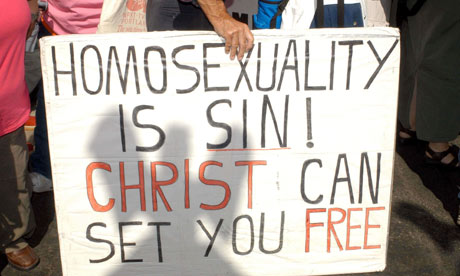
godhatesfags.com
- Chick-Fil-A 's opposition to same-sex marriage (and political contributions to organizations that oppose it) because of their company's "biblical values"  has just come to light recently.

Lots of churches and leaders were really upset about President Obama's statement in support of same-sex marriage.  Obama's statement prompted Pastor Charles Worley of Providence Road Baptist Church in Maiden, N.C. to preach to his congregation that gay and lesbian people should be confined within a large electrified fence, with food dropped in.  "In a few years, they'll die out."

godhatesfags.com
- One of my good friends said:  "The comments section on nearly every news article about gay marriage is always full of some of the worst Christian polemic."  Here's one such article, with said comments.  Here's a YouTube video of Rachel Maddow talking about Rick Warren and Obama, with similar comments.

- Speaking of Rachel Maddow, the above video goes into an interview with him (because he was scheduled to do Obama's inaugural kick-off).  Bishop Robinson continues to receive death threats and is choosing to retire early, in 2013, as a result of them.  His book In the Eye of the Storm addresses this issue.  Here's a clip of Jon Stewart talking about the ordination back in 2003... including statements from the opposition, and from then-President George W. Bush.

- Exodus International is one of the biggest organizations that used to help Christian gays become Christian ex-gays.  They've recently shifted their focus from "curing" homosexuality to abstaining from it.  So...yay?

 Sipa Press/Rex Features
- One Million Moms is an organization (with 48,000 likes on Facebook) of moms protesting things like gay couples in JCPenney ads, the rainbow Oreo ad, television shows with LGBTQ characters, and so forth, while celebrating Chick-Fil-A's commitments:  "Thank YOU Chick-fil-a for taking a stand! We support you and stand with you! Click on link to read article with direct quotes from the Chick-fil-a President that states they support traditional marriages, families, and Biblical principles."

- One Million Moms is a branch of the American Family Association, which is a Christian organization that wants to stop the spread of the "radical homosexual agenda," guided by these principles:

1.  The scripture declares that homosexuality is unnatural and sinful. It is a sin grievous to God and repulsive to Christians because it rejects God's design for mankind as heterosexual beings.
2.  Though there may be many influences in a person's life, the root of homosexuality is a sinful heart. Therefore, homosexuals have only one hope of being reconciled to God and rejecting their sinful behavior - faith in Jesus Christ alone. AFA seeks to use every opportunity to promote and encourage the efforts of ex-homosexual ministries and organizations.
3.  It is the duty of individual Christians and Christ's Church corporately to bring the gospel to homosexuals and to speak out against the acceptance of sin in our culture.
4.  We oppose the homosexual movement's efforts to convince our society that their behavior is normal because we fear the judgement of God on our nation.
(and so forth.)

- Have you heard of Focus on the Family?

Truth in Action just recently asserted the following about the shooting in Aurora:
Jackson: I think the sources of this is multifaceted but you can put it all I think under the heading of rebellion to God, a rejection of the God of the Bible. I think along with an education system that has produced our lawyers, our politicians, more teachers, more professors, all of that sort of thing, is our churches, mainline churches. We’ve been dealing Teddy and I know the AFA Journal has been dealing with denominations that no longer believe in the God of the Bible, they no longer believe that Jesus is the only way of salvation, they teach that God is OK with homosexuality, this is just increasing more and more. It is mankind shaking its fist at the authority of God.
James: And God will not be silent when he’s mocked, and we need to remember that.
Jackson: We are seeing his judgment. You know, some people talk about ‘God’s judgment must be just around the corner,’ we are seeing it.
Here are some more of their statements on LGBTQ people.

- LGBTQ people face discrimination daily: in the workplace, in housing, in adoption processes, in hospital visits, and other such legal recognitions of our existence.  Here's a really neat infographic from the Guardian to show you what I mean.  It's not entirely surprising that the more religious states, like those in the Bible Belt, have fewer legal provisions for us.

- I asked friends on Facebook if they had any personal accounts to add to this.  One acquaintance sent the following as a private message (because she has family on Facebook):

My uncle has recently been emailing me statements about my homosexuality and relationship with my partner of two years. He goes so far as to say that I am discounting the entire Bible and living a life of sin.  Another uncle has told me that I cannot be a "child of God" if I am in a same-gendered relationship. Keep in mind that these are family members who I have been close to for nearly 25 years. I have to wonder, if family members are willing to sever their ties on such Biblical basis, what about people who don't even know me? Might their hate run even deeper, since there is no personal connection?
And here's my personal experience.

Now -- maybe you don't see these examples as hate.  As I've indicated, plenty of Christians don't.  They think they're saving LGBTQ people by telling them their sexual orientation and gender identities are sinful.  Your own blog links to some pages critiquing the ELCA, for its 2009 vote along with other stances it has taken.

If that's your stance, then perhaps we have other things to talk about.

I've got time, as you can see.

Let me know.

My personal experience with hate, sexuality, and the Church.

When I came out in high school, one of my friends told me I was going to hell.  I was pretty lucky that it was just one, really.  I was lucky to be born into a family and a congregation that taught me I was beloved in God's eyes, and that my sexuality had nothing to do with that.

But that family and congregation couldn't shield me from the rest of the church.

Here's an excerpt from my account of my experience in an Assembly of God church in high school, circa 2002:
The preacher says, "But the greatest threat to our teenagers today..."

I hope that he will say depression, or anxiety, or loneliness.  I am fighting all three.  I think everyone is lonely.  Maybe if we admit it, we can defeat it, together in our loneliness.

"The single most sinful threat to their very lives...

is homosexuality."

My throat closes.

I see Bekah's head turn.  She is looking at me.  I cannot move.  I cannot think.  Everything is slowing down and speeding up.  I hear his words but they have become an angry babble, a hellfire spreading through my heart.

He condemns them, and condemns me.

I close my eyes, praying for something, anything to happen.  Please God, please.  But nothing happens.  He continues - his voice louder - his shouts beating down the pulse of my heart.  I am naked before all of them.

Without knowing that I am, I am standing.

He pauses and looks at me, but continues preaching.  I am standing, silent, and then I am turning and walking out.

I have taken off my shoes, as many of us do to start worship; I am barefoot, my sandals left in the sanctuary with my Bible and purse.  I cannot turn back. 

I push open the door to the lobby, and stand in the light there.  Finally the vise around my heart releases, and a flood of tears overcomes me.  My bare feet carry me to the girls' bathroom.

I weep.  Oh God, oh God.  I do not even know what I am crying for; only that I feel so impossibly and irrevocably broken that even God will not hear me.

But someone does; there is someone else in the bathroom now.  I hope that it is Bekah, and it is - she calls my name.

But when I come from the stall, there is someone else with her - one of the youth leaders, J.  J has dark hair and bright blue eyes, and I've never talked to her before; tonight, she is full focused on me.

She begins barraging me.  What is in you that made you abandon worship?  I cannot answer. She assumes, and continues.  What kind of wicked temptation is this?  I cannot answer.

She softens a little.  I was tempted too, you know, when I was your age...

And so begins a story I only half-hear, about temptation and sin and damnation.  Her words pound against me.  I am no longer in myself; I am floating above, trying to escape.  Bekah stands, unsure, seventeen years old, powerless.  J leans closer, nailing the words of condemnation against my skin.  I am trapped.  Everything I have ever learned about God and Jesus and love falls away.
I left that church that night, and never went back.

In 2003, the General Convention of the Episcopal Church met in Minneapolis to vote on, among other things, the election of Gene Robinson as bishop.  He would be the first openly gay and partnered man to serve as bishop of the Episcopal church.  We were already ordaining gay and lesbian people at the time; this was a vote to recognize that the New Hampshire diocese had elected him to be bishop.  The vote passed.  Three to two.  We had been ordaining openly gay and lesbian people since 1993 and still, forty percent of the church was not willing to welcome Robinson as bishop.

I was helping take care of attendees' kids during the Convention.  We had to house it off-site because we didn't want the kids seeing Westboro Baptist Church, with their God Hates Fags signs, standing outside the convention doors.

Robinson wore a bulletproof vest under his alb the day he was installed as bishop, as a result of the death threats he received that week.

I don't know how to explain to you how that feels.  I don't know what words to use to describe the tension between knowing God had called me to serve and knowing that there were people who wanted me dead in the name of God -- people who thought that God had called them to kill gay and lesbian people who tried to serve.

I got lucky, in some ways; I went to Saint Olaf, a Lutheran school with a deep love for service.  I was welcomed on the Student Congregation Council.  I was elected the chaplain for the Saint Olaf Choir my senior year, awarded distinction in the religion department, inducted into the honors society for classical languages (for my classes in ancient Greek).  I met my partner there.  In general, I wasn't "not allowed" to do religious things because of my sexuality.

But I also didn't come out to my roommate for three months because I was sure that she, the daughter of a small-town Lutheran pastor, would reject me.

I walked into my freshmen-year shared bathroom one morning to find a condemnation of gay and lesbian people anonymously posted in a stall, along with Bible verses.

I participated in the ELCA study on sexuality, Journey Together Faithfully, where we read and in-depth discussed those same verses, Leviticus 18:22 and 1 Corinthians 6:9 and Romans 1:18-32, where one possible concluding position was "Blessing same-sex unions would contradict the Bible's judgment against same-sex conduct and undermine the institution of marriage."

I was a Junior Counselor (an RA for freshmen) and my roommate and I discussed for hours how our group of first-year girls would react if, on a group date, I brought my girlfriend.

I took a senior-level seminar on Christianity and sexuality, wherein some of my classmates -- people I'd spent four years studying and spending time with -- told me my relationship wasn't legitimate, either by natural law or in the eyes of God.

I took three years off between college and seminary, ostensibly to save money for grad school, but in truth to see whether the ELCA would decide to formally accept openly partnered gay and lesbian people, or if we would continue to be consigned to a side process of ordination because we were technically violating churchwide policies.

In 2009, the Evangelical Lutheran Church in America, to which I belong, voted to allow the ordination of people in publicly accountable lifelong monogamous same-gender relationships.  Note:  allow.  Not call for, not rejoice in, not promote, but allow.  The vote barely passed.  During the vote, a thunderstorm and tornado struck, which John Piper (a local preacher) chose to interpret for the world as God's judgment on us.

That fall, my first day at seminary, one of the first fellow students I met was a young man who proudly declared he was one of the youngest voting members of the ELCA to vote against the ordination of gays.

I am lucky, in some ways.  I have a partner who loves me.  I have a congregation who supports me.  I have friends who are ridiculously persistent in their insistence that I am a blessed and beloved child of God regardless of my gender.  And the ELCA, God willing, will ordain me.

And yet I wake every day to new notices in my email inbox that Sojourners doesn't want to take a stance on whether I am welcome.  I have coffee with an acquaintance only to learn that I'm invited to write an article for the local LGBTQ magazine, to assert that not all church people hate gays.  I walk into a stranger's hospital room to provide spiritual care and have to decide if I will out myself.  I spend hours trying to cultivate a love for Scripture after having been beaten with it for years.

A friend said, when I posted about this on Facebook, wrote, "I think the hardest piece of it to see can also be the most painful. It's not as visible as the in-your-face blatant attacks, but the more disguised, 'I'll love you despite your sin' attitude that is more passive but so hurtful and condescending. I think it is the much more pervasive attitude among Christians, and much more difficult to reconcile."

She's right.

Asking me to describe the hate my Christian "brothers and sisters" direct at me every day is like a bird trying to describe air.  I know it, I live in it, I breathe it -- to what do I compare it?  How do I explain that Chick-Fil-A's "biblical values" as a company, or some pastor in North Carolina wanting to "round up all the gays and lesbians" and lock us in an electrified fence -- these aren't just news articles, silly remnants of a time gone by, a place that doesn't matter.

These are reminders that there are people out there who are dedicated to making sure that I can't marry my wife, that I can't legally share children or healthcare or a pension plan with her -- people who will write angry letters to the seminary or the bishop, people who get shows on Fox News and declare my life an abomination unto the God I strive to serve, because of the very same Bible I am trying so hard to love.

I live everyday still in that tension of knowing God calls me to serve, and some people of God may try to kill me for it.

Monday, July 9, 2012

"How do you remind yourself that you are a beloved child of God?"

anthropoidia asked you:
Hi! I just started following you. I’m a trans guy, recently refinding my faith. Can I ask you a preacherish question? How do you deal with the mountains of LGBT directed hatred from Christians? How do you remind yourself that you are a beloved child of God? How do you keep from internalizing that hatred? I ask because I find it very difficult to do myself, and I thought maybe reaching out to another queer person of faith might help. All the best, I really enjoy your blog, and many blessings!
Well hi!  Welcome, and stuff.  It’s taken me a while to recognize my own belovedness, but here are the things that hold me up on a daily basis. 

(Full disclosure:  I grew up in an Episcopal congregation that fully welcomed gay and lesbian people, and in a family that did too.  I now study and serve in a denomination, the Evangelical Lutheran Church in America, who will allow me to serve openly as a queer woman in a partnered relationship.  Some of the things that work for me might not work as well for people who were raised or are now living in less supportive situations.  But, here’s my experience.) 

1.  I have friends to remind me.  This may or may not be easy to do, depending on where you are (both geographically and in your own life’s journey).  But I do believe that one way to remember how loved and beloved I am is to have friends that treat me as such.  I seek out like-minded people (most of us do!) and keep up with them however I can.   I especially seek out people who remind me willingly — I don’t have to “go fishing” for support from them.  If I say “Let’s run in this 5K to raise money to defeat the constitutional marriage amendment,” they say “Awesome, let's make T-shirts!” and not “Why?”.  

That’s not to say I’m not also friends with people who don’t think that I can be in a publicly accountable, lifelong, monogamous, same-gender relationship and still serve God.  I am, and those friendships are important and can be transformational.  

But for the most part, I have friends who support me.   And that goes for everything — not just my sexuality.  My closest friends are the ones who remind me that they care about me and want me in their life. 

So cultivate those friendships — and remind those friends that you care about them, too, and care about having them in your life.  That will take different forms for different people.  Maybe you remind people you care by texting randomly, or giving great bear hugs, or leaving funny comments on Facebook, or whatever.  Do what seems authentic to you, but do it.  Find people who support you, and remind them how important they are to you. 

2.  I go to a church that reminds me.  Again, this is the kind of thing that varies by region.  Gaychurch.org is great for finding out who in your area might welcome you.  Welcomingresources.org has a similar list, and maps them in Google so you can see who’s nearby.  When Kristi (my partner) and I started looking for a church, the very first qualification was that they welcome us unequivocally. 

I’ve also gotten to a point in my leadership formation where I have no intention of ever sitting through a sermon that condemns me.  I’ll walk out.  (But I’ll walk out of bad sermons in general — I’m rebellious like that.) 

3.  I read lots of things by people that remind me.  If you follow me on Tumblr, you know I’m constantly posting quotes from articles and books I read.  Here’s a short list of things that have really helped (and continue to!). 

Blogs / websites: 

- Patheos has a new blogroll on its Progressive Christian Channel called Coming Out Christian; there are some really great posts by lots of different writers. 

- The Gay Christian Network on Facebook is great to follow. 

- Sojourners has failed to consistently take a pro-welcome stance, but they have a great list of resources (books, movies, articles, etc.) about LGBTQ inclusion here

- Inclusive Orthodoxy has some great articles too. 

- Nadia Bolz-Weber.  She’s a bad-ass, life-changing super-Lutheran pastor out of Denver where she started a brand-new church, which is (among other things) queer inclusive.  She is deeply into God's grace and love for us despite how we treat ourselves, how we treat each other, how others treat us, etc.  She blogs about it and posts her sermons here.  I rabidly fangirl about her (and then she finds it and comments on it, with utmost grace and kindness) here

Rachel Held Evans.  A straight, white, conservative evangelical woman who, through her experiences with LGBTQ people, has come to a different understanding of what it means to be Christian, and what it means to be biblical.  She’s a brilliant writer, and extraordinarily brave, and frequently features lots of different topics and voices on her blog. 

-Nakedpastor. David Hayward is a former pastor who now does comic-strip criticisms of common church behaviors.  He also does beautiful artwork of the inclusive Christ, for example, and a great series of Sophia, the woman freeing herself from tyrannical religion. 

Boggle Loves You.  Not queer-oriented specifically, but good grief that little owl is so sweet and cute. 

Books: 

To the Tune of a Welcoming God, a book by David Weiss.  I first got my hands on this back when it was a three-hole-punched collection of essays; now it’s a book and it’s better than ever.  It’s a mix of hymns/poetry, essays, and letters calling the Christian community to a full welcome for LGBTQ people.  It completely transformed my understanding of the Gospel and how it calls for a full welcome. 

Take This Bread is the story of journalist, atheist, and lesbian Sara Miles becoming a Christian and starting food pantries as a result of the experience of the Eucharist.  Her story makes lumps rise in my throat every time. 

Manna and Mercy, a book by Daniel Erlander.  A retelling of the Biblical story, it’s not queer-focused per se, but has great feminist and liberation theology undertones.  I’ve struggled a lot with learning to love Scripture (since it’s been used against me!) and this book really helped me reclaim the story that God wants to call us into. 

The Great Emergence, by Phyllis Tickle.  She claims that the church has a “rummage sale” every five hundred years and decides what to keep and what to sell / toss.  See:  the Great Schism, the Reformation, etc.  Her belief is that we’re in another rummage sale.  It helped me contextualize the changes I see in the church (and the big changes coming). 

- Anne Lamott, especially Plan B.  She’s irreverently reverent and deeply hilarious, and very committed to the intersection of social justice and the church.  Her vulnerability helps me come back to myself when I have rough days.  She also has a fantastic Facebook account where she narrates her daily life in the same voice in which she writes her memories, which delights me to no end. 

4.  I have a killer playlist to remind me.  Laugh if you want, but sometimes what a queer girl needs is to put on P!nk’s “F**ckin’ Perfect” at volume 11 and sing along until her throat is raw. Here’s some other selections: 

  • P!nk, “Ave Mary A”, ”Raise Your Glass”, ”So What”, “Stupid Girls.”  
  • Sara Groves (If you don’t know Sara Groves, she’s a fantastic Christian artist from Minnesota whose album Fireflies & Songs was Christianity Today’s top album of 2009.  I have loved her since 2001 and she’s only gotten better and better.):  ”When It Was Over,” “You Cannot Lose My Love,” “Why It Matters,” “Less Like Scars,” “Remember Surrender,” “Maybe There’s a Loving God,” “Cave of Adullum,” “From This One Place,” “Like a Lake.”  (Did I mention that I LOVE HER.)
  • Jennifer Knapp’s album Letting Go, especially “Dive In,” but the whole album is just fantastic.  If you just barely recognize that name, it’s because she was a Christian artist until about seven years ago when she disappeared from the concert circuit.  She stayed in Australia for most of that time and then came back to America and to music recording… after coming out.  Yeah.  Badass.  So guess what else — she has a website called Inside Out Faith, where she talks about being gay and Christian.  Yay!
  • Lady Gaga.  ”Born This Way.”  Obviously.
  • Katy Perry.  ”Firework.”  Even though I’m still mad about “Ur So Gay.”
  • Wicked’s “Defying Gravity.” 
  • If I were a closet Gleek (not sayin’ that I am, I’m just sayin’) I would probably sing along to “Don’t Stop Believin,” ”Forget You,” ”Loser Like Me”, “Light Up the World,” “Hit Me With Your Best Shot / One Way or Another,” and “Survivor / I Will Survive.”  I’d probably cry whenever Lea Michele sings “Don’t Rain On My Parade.”  And I’d have an entire car-dance choreographed to “Give Up the Funk.”  …Yeah, go ahead and judge me.  I’m OK with it.  :)
You know what?  I'll just make you a playlist.  :)


5.  But what it comes down to at the end of the day is that I believe in the Gospel, which reminds me.  The gospel is the foundation of everything above this.  

I believe that I and my queer brothers and sisters stand in the light of the long arc of God's dream for the world.  That God calls us, points us, pulls us into a world defined by compassion, justice, and righteousness -- into a world where we are freed from bonds that keep us from loving ourselves, our God, and our neighbors. 

I believe that God acts to cross boundaries, to break down walls, to continually expand the circle of God's welcome beyond where we are comfortable. 

We see God's radical reach writ large across the narrative of the Hebrew Bible -- 

-- in Sarah and Abraham, called to be the ancestors of God's chosen people, who were far too old to bear children, who doubted, who struggled, who laughed behind a tent flap at God's messengers' proclamation; 

-- in Rahab, the Gentile prostitute, who trusted in the God of the Hebrews and became part of their family, and and is one the ancestors of Jesus; 

-- in Ruth, a Gentile who lost her husband but remained faithful to her Hebrew mother-in-law, and became the grandmother of Jesse; 

-- in the Gentile citizens of Nineveh, spared from destruction by the words of the reluctant prophet Jonah; 

-- in the words spoken through the prophets:  by Hosea, "I will say to those called 'Not my people, ' 'You are my people'; and they will say, 'You are my God.' ", and from Isaiah:  "See, I am doing a new thing!" 

Over and over again, the God of the Hebrew people looked at the carefully drawn lines between "God's people" and "Not God's people" -- and crossed them, destroyed them, never looked back. 

And that same kind of radical reach, that call to all to come and be a part of God's kingdom despite their age, their sex, their race, is found in abundance in Immanuel, God-with-us, Christ Jesus. 

Jesus did not turn away from the bleeding woman who touched him, or the possessed, or the lepers, or the blind -- all unclean, unwanted, outside of the community.  He praised the faith of a Roman centurion -- the enemy, the ruling force, a Gentile whose job was to oppress Jews.  He spoke with Samaritans, the theological competition; he offered one as an example of true neighborly love.  

He socialized with women.  He blessed little children.  He pointed to troublesome mustard weeds, to careless shepherds, to wasteful sowers and said, "That.  That kind of extravagance is the kingdom of God." 

Those who pushed back against him -- who wanted to keep the lines clear, the walls strong, the separation between God's People and Not God's People certain and uncrossable -- are the ones he turned away from. 

And when he was raised, he appeared not to Peter the rock, not to John the beloved, not to his enemies to convince them, not to scribes who could record the miracle or Romans who could deify him, but to women -- to what society thought of as "unreliable witnesses" -- to one woman in particular, Mary Magdalene, out of whom had been cast seven demons.  In his resurrection, he crossed the boundaries yet again. 

When the Spirit blew at Pentecost, when Peter saw a vision of unclean animals, when God's voice and a blinding light knocked Paul from his horse, when Philip met the Ethiopian sitting in his chariot -- each and every time God burst through doors, broke down walls of language and religion and ethnicity and race and gender, crossed uncrossable boundaries and set up camp in hearts of people once called Not God's People. 

That is why I want to do what I want to do -- because I believe in the message of the Gospel, and I believe in it for everyone.