Monday, July 23, 2012

Hate, sexuality, and the Church


Tony left this comment on my blog this weekend:
I just started reading your blog too.

I don't see, or maybe I just don't recognize recognize the "hate" from Christians toward the homosexual community. In fact, I see the opposite. Many mainline, large, wealthly demoninations experience huge membership loss, criticism, and financial costs in order to support homosexual rights and inclusion. Even the largest (by numbers) Roman Catholic Church has been reaching out since I was in college (and that was before you were born! - ugh)

I do see in many non-Christian values countries the public execution and torture of homosuexuals, threats, and imprisionment.

Can you point out some examples to a middleclass guy that works for a Fourtune 500 company?
Thanks for reading and commenting, Tony.

I'd like to first address a couple of your side comments, and then we'll get to the actual question you asked.


First, just so you know, "homosexual" is rather an outdated term.  

"Gay" is more appropriate, "LGBTQ" more inclusive.  "Homosexual" is still in use in some places, especially within the church (always a bit slow to move on things like this), but it's not usually the preferred term by LGBTQ people.


The "mainline, large, wealthy denominations" are not experiencing "huge membership loss, criticism, and financial costs" when they "support homosexual inclusion."

I'm not convinced by either data or experience that mainline Protestant churches are losing members and money because of the full inclusion of LGBTQ people.

Data from the Pew Research Forum on Religion and Public Life and the General Social Surveys through the National Opinion Research Center put the first sign of mainline Protestant downturn in the early 1990s.  

At that point, the Evangelical Lutheran Church in America was still a decade away from its first official study on sexuality ("Journey Together Faithfully," 2002) and nearly two decades away from the official churchwide position that individual churches will not be censured if they choose to call someone in a "publicly accountable, lifelong, monogamous, same-gender relationship" (2009) to serve as their pastor.

The United Methodist Church is presently "in decline", even though the policy has been (since 1972) and still is that "homosexual practice" is "incompatible with Christian teaching."  

Tom Ehrich, Episcopal priest, dates mainline Protestant decline to 1965.

In addition, support for equal rights for LGBTQ persons is growing.  If acceptance of LGBTQ people determines a church's population, we should see increases in liberal mainline Protestant churches, not decreases.

On top of that, there is little consensus among churches within mainline Protestant denominations.  Episcopalians continue to struggle with the ordination of gay and lesbian people, as evidenced by the recent debate over the Anglican Covenant.  Presbyterian polity allows for the ordaination gay clergy but does not recognize same-sex couples as married.  The United Church of Christ has a constitution that doesn't require congregations to agree with all of the statements of the national office, so significant diversity exists within the UCC as far as ordination and marriage.  

If only the congregations that fully welcomed and included LGBTQ people were dying, we might have good data -- but that's not the case.  Congregations on both sides (if we reduce this to "liberal" and "conservative") are losing members.

So no -- I don't believe that mainline Protestant churches are losing members and money simply because of the full inclusion of LGBTQ people.  I think the decline in the mainline Protestant church is multifaceted, and lots of people have lots of different opinions about where the roots lie.  But, short answer (since this isn't the question you asked, anyway!):  no.  That's not what's going on.


In addition, I think you and I may be operating from different concepts of "reaching out."  You wrote:  "Even the largest (by numbers) Roman Catholic Church has been reaching out since I was in college."

I'm not certain what you're referring to here, because this is the Roman Catholic Church's official position on homosexuality, as stated in the Catechism (1997 edition):

2357 Homosexuality refers to relations between men or between women who experience an exclusive or predominant sexual attraction toward persons of the same sex. It has taken a great variety of forms through the centuries and in different cultures. Its psychological genesis remains largely unexplained. Basing itself on Sacred Scripture, which presents homosexual acts as acts of grave depravity, tradition has always declared that "homosexual acts are intrinsically disordered." They are contrary to the natural law. They close the sexual act to the gift of life. They do not proceed from a genuine affective and sexual complementarity. Under no circumstances can they be approved.

2358 The number of men and women who have deep-seated homosexual tendencies is not negligible. This inclination, which is objectively disordered, constitutes for most of them a trial. They must be accepted with respect, compassion, and sensitivity. Every sign of unjust discrimination in their regard should be avoided. These persons are called to fulfill God's will in their lives and, if they are Christians, to unite to the sacrifice of the Lord's Cross the difficulties they may encounter from their condition.

2359 Homosexual persons are called to chastity. By the virtues of self-mastery that teach them inner freedom, at times by the support of disinterested friendship, by prayer and sacramental grace, they can and should gradually and resolutely approach Christian perfection.

The RCC's official ministry for people with same-sex attraction is Courage, which teaches chastity.

There's a constitutional amendment on Minnesota state ballots this year to define marriage as one man and one woman.  We who oppose this measure have raised $3.1 million this calendar year to defeat it.  Those who support it have raised $588,000.  $400,000 (almost 70%) of that came from the Minnesota Catholic Conference Defense Fund.

Now, you could be referring to the work of individual groups, congregations, persons, etc.  That's fair; there are plenty of Catholics who are fully welcoming to LGBTQ people.  Still, to say "The RCC is reaching out to homosexuals" on that evidence alone would be like saying "The RCC is open to non-natural birth control."  Sure, within the church, there's a diversity of practice as far as birth control, but the official position is not so diverse.


You also said, "I do see in many non-Christian values countries the public execution and torture of homosuexuals, threats, and imprisionment."

I think what you are saying is that you see in countries without Christian values that there is public execution, torture, threats, imprisonment.

I'm honestly at a loss at what countries you're referring to here.  There are countries in Europe that are considered "post-Christian" -- Norway, Sweden, England, France, and the Netherlands come to mind most quickly -- but in almost every country that is "post-Christian", there is far more equality and acceptance for LGBTQ than there is here.

There is significant persecution of LGBTQ people in African countries, and in the Middle East.  You may have heard of the country's Anti-Homosexuality Bill in 2009 and 2010, by which all homosexual acts were declared criminal and deserving of life imprisonment or the death sentence.

Interestingly, this bill came into circulation shortly after a three-day conference on "curing" homosexuality was led by three American evangelical Christians.


But, having said all this, finally on to your question:  I don't see, or maybe I just don't recognize recognize the "hate" from Christians toward the homosexual community. ... Can you point out some examples to a middleclass guy that works for a Fourtune 500 company?

Sure can.

godhatesfags.com
- Chick-Fil-A 's opposition to same-sex marriage (and political contributions to organizations that oppose it) because of their company's "biblical values"  has just come to light recently.

- Lots of churches and leaders were really upset about President Obama's statement in support of same-sex marriage.  Obama's statement prompted Pastor Charles Worley of Providence Road Baptist Church in Maiden, N.C. to preach to his congregation that gay and lesbian people should be confined within a large electrified fence, with food dropped in.  "In a few years, they'll die out."

godhatesfags.com
- One of my good friends said:  "The comments section on nearly every news article about gay marriage is always full of some of the worst Christian polemic."  Here's one such article, with said comments.  Here's a YouTube video of Rachel Maddow talking about Rick Warren and Obama, with similar comments.

- Speaking of Rachel Maddow, the above video goes into an interview with him (because he was scheduled to do Obama's inaugural kick-off).  Bishop Robinson continues to receive death threats and is choosing to retire early, in 2013, as a result of them.  His book In the Eye of the Storm addresses this issue.  Here's a clip of Jon Stewart talking about the ordination back in 2003... including statements from the opposition, and from then-President George W. Bush.

- Exodus International is one of the biggest organizations that used to help Christian gays become Christian ex-gays.  They've recently shifted their focus from "curing" homosexuality to abstaining from it.  So...yay?
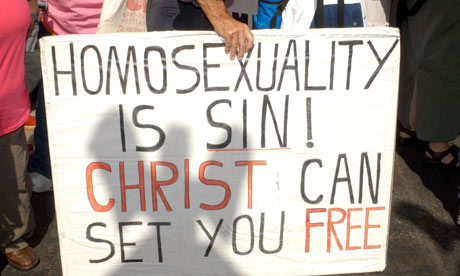
 Sipa Press/Rex Features
- One Million Moms is an organization (with 48,000 likes on Facebook) of moms protesting things like gay couples in JCPenney ads, the rainbow Oreo ad, television shows with LGBTQ characters, and so forth, while celebrating Chick-Fil-A's commitments:  "Thank YOU Chick-fil-a for taking a stand! We support you and stand with you! Click on link to read article with direct quotes from the Chick-fil-a President that states they support traditional marriages, families, and Biblical principles."

- One Million Moms is a branch of the American Family Association, which is a Christian organization that wants to stop the spread of the "radical homosexual agenda," guided by these principles:

1.  The scripture declares that homosexuality is unnatural and sinful. It is a sin grievous to God and repulsive to Christians because it rejects God's design for mankind as heterosexual beings.
2.  Though there may be many influences in a person's life, the root of homosexuality is a sinful heart. Therefore, homosexuals have only one hope of being reconciled to God and rejecting their sinful behavior - faith in Jesus Christ alone. AFA seeks to use every opportunity to promote and encourage the efforts of ex-homosexual ministries and organizations.
3.  It is the duty of individual Christians and Christ's Church corporately to bring the gospel to homosexuals and to speak out against the acceptance of sin in our culture.
4.  We oppose the homosexual movement's efforts to convince our society that their behavior is normal because we fear the judgement of God on our nation.
(and so forth.)

- Have you heard of Focus on the Family?

- Truth in Action just recently asserted the following about the shooting in Aurora:
Jackson: I think the sources of this is multifaceted but you can put it all I think under the heading of rebellion to God, a rejection of the God of the Bible. I think along with an education system that has produced our lawyers, our politicians, more teachers, more professors, all of that sort of thing, is our churches, mainline churches. We’ve been dealing Teddy and I know the AFA Journal has been dealing with denominations that no longer believe in the God of the Bible, they no longer believe that Jesus is the only way of salvation, they teach that God is OK with homosexuality, this is just increasing more and more. It is mankind shaking its fist at the authority of God.
James: And God will not be silent when he’s mocked, and we need to remember that.
Jackson: We are seeing his judgment. You know, some people talk about ‘God’s judgment must be just around the corner,’ we are seeing it.
Here are some more of their statements on LGBTQ people.

- LGBTQ people face discrimination daily: in the workplace, in housing, in adoption processes, in hospital visits, and other such legal recognitions of our existence.  Here's a really neat infographic from the Guardian to show you what I mean.  It's not entirely surprising that the more religious states, like those in the Bible Belt, have fewer legal provisions for us.

- I asked friends on Facebook if they had any personal accounts to add to this.  One acquaintance sent the following as a private message (because she has family on Facebook):

My uncle has recently been emailing me statements about my homosexuality and relationship with my partner of two years. He goes so far as to say that I am discounting the entire Bible and living a life of sin.  Another uncle has told me that I cannot be a "child of God" if I am in a same-gendered relationship. Keep in mind that these are family members who I have been close to for nearly 25 years. I have to wonder, if family members are willing to sever their ties on such Biblical basis, what about people who don't even know me? Might their hate run even deeper, since there is no personal connection?
- And here's my personal experience.

Now -- maybe you don't see these examples as hate.  As I've indicated, plenty of Christians don't.  They think they're saving LGBTQ people by telling them their sexual orientation and gender identities are sinful.  Your own blog links to some pages critiquing the ELCA, for its 2009 vote along with other stances it has taken.

If that's your stance, then perhaps we have other things to talk about.

I've got time, as you can see.

Let me know.

My personal experience with hate, sexuality, and the Church.

When I came out in high school, one of my friends told me I was going to hell.  I was pretty lucky that it was just one, really.  I was lucky to be born into a family and a congregation that taught me I was beloved in God's eyes, and that my sexuality had nothing to do with that.

But that family and congregation couldn't shield me from the rest of the church.

Here's an excerpt from my account of my experience in an Assembly of God church in high school, circa 2002:
The preacher says, "But the greatest threat to our teenagers today..."

I hope that he will say depression, or anxiety, or loneliness.  I am fighting all three.  I think everyone is lonely.  Maybe if we admit it, we can defeat it, together in our loneliness.

"The single most sinful threat to their very lives...

is homosexuality."

My throat closes.

I see Bekah's head turn.  She is looking at me.  I cannot move.  I cannot think.  Everything is slowing down and speeding up.  I hear his words but they have become an angry babble, a hellfire spreading through my heart.

He condemns them, and condemns me.

I close my eyes, praying for something, anything to happen.  Please God, please.  But nothing happens.  He continues - his voice louder - his shouts beating down the pulse of my heart.  I am naked before all of them.

Without knowing that I am, I am standing.

He pauses and looks at me, but continues preaching.  I am standing, silent, and then I am turning and walking out.

I have taken off my shoes, as many of us do to start worship; I am barefoot, my sandals left in the sanctuary with my Bible and purse.  I cannot turn back. 

I push open the door to the lobby, and stand in the light there.  Finally the vise around my heart releases, and a flood of tears overcomes me.  My bare feet carry me to the girls' bathroom.

I weep.  Oh God, oh God.  I do not even know what I am crying for; only that I feel so impossibly and irrevocably broken that even God will not hear me.

But someone does; there is someone else in the bathroom now.  I hope that it is Bekah, and it is - she calls my name.

But when I come from the stall, there is someone else with her - one of the youth leaders, J.  J has dark hair and bright blue eyes, and I've never talked to her before; tonight, she is full focused on me.

She begins barraging me.  What is in you that made you abandon worship?  I cannot answer. She assumes, and continues.  What kind of wicked temptation is this?  I cannot answer.

She softens a little.  I was tempted too, you know, when I was your age...

And so begins a story I only half-hear, about temptation and sin and damnation.  Her words pound against me.  I am no longer in myself; I am floating above, trying to escape.  Bekah stands, unsure, seventeen years old, powerless.  J leans closer, nailing the words of condemnation against my skin.  I am trapped.  Everything I have ever learned about God and Jesus and love falls away.
I left that church that night, and never went back.

In 2003, the General Convention of the Episcopal Church met in Minneapolis to vote on, among other things, the election of Gene Robinson as bishop.  He would be the first openly gay and partnered man to serve as bishop of the Episcopal church.  We were already ordaining gay and lesbian people at the time; this was a vote to recognize that the New Hampshire diocese had elected him to be bishop.  The vote passed.  Three to two.  We had been ordaining openly gay and lesbian people since 1993 and still, forty percent of the church was not willing to welcome Robinson as bishop.

I was helping take care of attendees' kids during the Convention.  We had to house it off-site because we didn't want the kids seeing Westboro Baptist Church, with their God Hates Fags signs, standing outside the convention doors.

Robinson wore a bulletproof vest under his alb the day he was installed as bishop, as a result of the death threats he received that week.

I don't know how to explain to you how that feels.  I don't know what words to use to describe the tension between knowing God had called me to serve and knowing that there were people who wanted me dead in the name of God -- people who thought that God had called them to kill gay and lesbian people who tried to serve.

I got lucky, in some ways; I went to Saint Olaf, a Lutheran school with a deep love for service.  I was welcomed on the Student Congregation Council.  I was elected the chaplain for the Saint Olaf Choir my senior year, awarded distinction in the religion department, inducted into the honors society for classical languages (for my classes in ancient Greek).  I met my partner there.  In general, I wasn't "not allowed" to do religious things because of my sexuality.

But I also didn't come out to my roommate for three months because I was sure that she, the daughter of a small-town Lutheran pastor, would reject me.

I walked into my freshmen-year shared bathroom one morning to find a condemnation of gay and lesbian people anonymously posted in a stall, along with Bible verses.

I participated in the ELCA study on sexuality, Journey Together Faithfully, where we read and in-depth discussed those same verses, Leviticus 18:22 and 1 Corinthians 6:9 and Romans 1:18-32, where one possible concluding position was "Blessing same-sex unions would contradict the Bible's judgment against same-sex conduct and undermine the institution of marriage."

I was a Junior Counselor (an RA for freshmen) and my roommate and I discussed for hours how our group of first-year girls would react if, on a group date, I brought my girlfriend.

I took a senior-level seminar on Christianity and sexuality, wherein some of my classmates -- people I'd spent four years studying and spending time with -- told me my relationship wasn't legitimate, either by natural law or in the eyes of God.

I took three years off between college and seminary, ostensibly to save money for grad school, but in truth to see whether the ELCA would decide to formally accept openly partnered gay and lesbian people, or if we would continue to be consigned to a side process of ordination because we were technically violating churchwide policies.

In 2009, the Evangelical Lutheran Church in America, to which I belong, voted to allow the ordination of people in publicly accountable lifelong monogamous same-gender relationships.  Note:  allow.  Not call for, not rejoice in, not promote, but allow.  The vote barely passed.  During the vote, a thunderstorm and tornado struck, which John Piper (a local preacher) chose to interpret for the world as God's judgment on us.

That fall, my first day at seminary, one of the first fellow students I met was a young man who proudly declared he was one of the youngest voting members of the ELCA to vote against the ordination of gays.

I am lucky, in some ways.  I have a partner who loves me.  I have a congregation who supports me.  I have friends who are ridiculously persistent in their insistence that I am a blessed and beloved child of God regardless of my gender.  And the ELCA, God willing, will ordain me.

And yet I wake every day to new notices in my email inbox that Sojourners doesn't want to take a stance on whether I am welcome.  I have coffee with an acquaintance only to learn that I'm invited to write an article for the local LGBTQ magazine, to assert that not all church people hate gays.  I walk into a stranger's hospital room to provide spiritual care and have to decide if I will out myself.  I spend hours trying to cultivate a love for Scripture after having been beaten with it for years.

A friend said, when I posted about this on Facebook, wrote, "I think the hardest piece of it to see can also be the most painful. It's not as visible as the in-your-face blatant attacks, but the more disguised, 'I'll love you despite your sin' attitude that is more passive but so hurtful and condescending. I think it is the much more pervasive attitude among Christians, and much more difficult to reconcile."

She's right.

Asking me to describe the hate my Christian "brothers and sisters" direct at me every day is like a bird trying to describe air.  I know it, I live in it, I breathe it -- to what do I compare it?  How do I explain that Chick-Fil-A's "biblical values" as a company, or some pastor in North Carolina wanting to "round up all the gays and lesbians" and lock us in an electrified fence -- these aren't just news articles, silly remnants of a time gone by, a place that doesn't matter.

These are reminders that there are people out there who are dedicated to making sure that I can't marry my wife, that I can't legally share children or healthcare or a pension plan with her -- people who will write angry letters to the seminary or the bishop, people who get shows on Fox News and declare my life an abomination unto the God I strive to serve, because of the very same Bible I am trying so hard to love.

I live everyday still in that tension of knowing God calls me to serve, and some people of God may try to kill me for it.

Monday, July 9, 2012

"How do you remind yourself that you are a beloved child of God?"

anthropoidia asked you:
Hi! I just started following you. I’m a trans guy, recently refinding my faith. Can I ask you a preacherish question? How do you deal with the mountains of LGBT directed hatred from Christians? How do you remind yourself that you are a beloved child of God? How do you keep from internalizing that hatred? I ask because I find it very difficult to do myself, and I thought maybe reaching out to another queer person of faith might help. All the best, I really enjoy your blog, and many blessings!
Well hi!  Welcome, and stuff.  It’s taken me a while to recognize my own belovedness, but here are the things that hold me up on a daily basis. 

(Full disclosure:  I grew up in an Episcopal congregation that fully welcomed gay and lesbian people, and in a family that did too.  I now study and serve in a denomination, the Evangelical Lutheran Church in America, who will allow me to serve openly as a queer woman in a partnered relationship.  Some of the things that work for me might not work as well for people who were raised or are now living in less supportive situations.  But, here’s my experience.) 

1.  I have friends to remind me.  This may or may not be easy to do, depending on where you are (both geographically and in your own life’s journey).  But I do believe that one way to remember how loved and beloved I am is to have friends that treat me as such.  I seek out like-minded people (most of us do!) and keep up with them however I can.   I especially seek out people who remind me willingly — I don’t have to “go fishing” for support from them.  If I say “Let’s run in this 5K to raise money to defeat the constitutional marriage amendment,” they say “Awesome, let's make T-shirts!” and not “Why?”.  

That’s not to say I’m not also friends with people who don’t think that I can be in a publicly accountable, lifelong, monogamous, same-gender relationship and still serve God.  I am, and those friendships are important and can be transformational.  

But for the most part, I have friends who support me.   And that goes for everything — not just my sexuality.  My closest friends are the ones who remind me that they care about me and want me in their life. 

So cultivate those friendships — and remind those friends that you care about them, too, and care about having them in your life.  That will take different forms for different people.  Maybe you remind people you care by texting randomly, or giving great bear hugs, or leaving funny comments on Facebook, or whatever.  Do what seems authentic to you, but do it.  Find people who support you, and remind them how important they are to you. 

2.  I go to a church that reminds me.  Again, this is the kind of thing that varies by region.  Gaychurch.org is great for finding out who in your area might welcome you.  Welcomingresources.org has a similar list, and maps them in Google so you can see who’s nearby.  When Kristi (my partner) and I started looking for a church, the very first qualification was that they welcome us unequivocally. 

I’ve also gotten to a point in my leadership formation where I have no intention of ever sitting through a sermon that condemns me.  I’ll walk out.  (But I’ll walk out of bad sermons in general — I’m rebellious like that.) 

3.  I read lots of things by people that remind me.  If you follow me on Tumblr, you know I’m constantly posting quotes from articles and books I read.  Here’s a short list of things that have really helped (and continue to!). 

Blogs / websites: 

- Patheos has a new blogroll on its Progressive Christian Channel called Coming Out Christian; there are some really great posts by lots of different writers. 

- The Gay Christian Network on Facebook is great to follow. 

- Sojourners has failed to consistently take a pro-welcome stance, but they have a great list of resources (books, movies, articles, etc.) about LGBTQ inclusion here. 

- Inclusive Orthodoxy has some great articles too. 

- Nadia Bolz-Weber.  She’s a bad-ass, life-changing super-Lutheran pastor out of Denver where she started a brand-new church, which is (among other things) queer inclusive.  She is deeply into God's grace and love for us despite how we treat ourselves, how we treat each other, how others treat us, etc.  She blogs about it and posts her sermons here.  I rabidly fangirl about her (and then she finds it and comments on it, with utmost grace and kindness) here. 

- Rachel Held Evans.  A straight, white, conservative evangelical woman who, through her experiences with LGBTQ people, has come to a different understanding of what it means to be Christian, and what it means to be biblical.  She’s a brilliant writer, and extraordinarily brave, and frequently features lots of different topics and voices on her blog. 

-Nakedpastor. David Hayward is a former pastor who now does comic-strip criticisms of common church behaviors.  He also does beautiful artwork of the inclusive Christ, for example, and a great series of Sophia, the woman freeing herself from tyrannical religion. 

- Boggle Loves You.  Not queer-oriented specifically, but good grief that little owl is so sweet and cute. 

Books: 

- To the Tune of a Welcoming God, a book by David Weiss.  I first got my hands on this back when it was a three-hole-punched collection of essays; now it’s a book and it’s better than ever.  It’s a mix of hymns/poetry, essays, and letters calling the Christian community to a full welcome for LGBTQ people.  It completely transformed my understanding of the Gospel and how it calls for a full welcome. 

- Take This Bread is the story of journalist, atheist, and lesbian Sara Miles becoming a Christian and starting food pantries as a result of the experience of the Eucharist.  Her story makes lumps rise in my throat every time. 

- Manna and Mercy, a book by Daniel Erlander.  A retelling of the Biblical story, it’s not queer-focused per se, but has great feminist and liberation theology undertones.  I’ve struggled a lot with learning to love Scripture (since it’s been used against me!) and this book really helped me reclaim the story that God wants to call us into. 

- The Great Emergence, by Phyllis Tickle.  She claims that the church has a “rummage sale” every five hundred years and decides what to keep and what to sell / toss.  See:  the Great Schism, the Reformation, etc.  Her belief is that we’re in another rummage sale.  It helped me contextualize the changes I see in the church (and the big changes coming). 

- Anne Lamott, especially Plan B.  She’s irreverently reverent and deeply hilarious, and very committed to the intersection of social justice and the church.  Her vulnerability helps me come back to myself when I have rough days.  She also has a fantastic Facebook account where she narrates her daily life in the same voice in which she writes her memories, which delights me to no end. 

4.  I have a killer playlist to remind me.  Laugh if you want, but sometimes what a queer girl needs is to put on P!nk’s “F**ckin’ Perfect” at volume 11 and sing along until her throat is raw. Here’s some other selections: 

  • P!nk, “Ave Mary A”, ”Raise Your Glass”, ”So What”, “Stupid Girls.”  
  • Sara Groves (If you don’t know Sara Groves, she’s a fantastic Christian artist from Minnesota whose album Fireflies & Songs was Christianity Today’s top album of 2009.  I have loved her since 2001 and she’s only gotten better and better.):  ”When It Was Over,” “You Cannot Lose My Love,” “Why It Matters,” “Less Like Scars,” “Remember Surrender,” “Maybe There’s a Loving God,” “Cave of Adullum,” “From This One Place,” “Like a Lake.”  (Did I mention that I LOVE HER.)
  • Jennifer Knapp’s album Letting Go, especially “Dive In,” but the whole album is just fantastic.  If you just barely recognize that name, it’s because she was a Christian artist until about seven years ago when she disappeared from the concert circuit.  She stayed in Australia for most of that time and then came back to America and to music recording… after coming out.  Yeah.  Badass.  So guess what else — she has a website called Inside Out Faith, where she talks about being gay and Christian.  Yay!
  • Lady Gaga.  ”Born This Way.”  Obviously.
  • Katy Perry.  ”Firework.”  Even though I’m still mad about “Ur So Gay.”
  • Wicked’s “Defying Gravity.” 
  • If I were a closet Gleek (not sayin’ that I am, I’m just sayin’) I would probably sing along to “Don’t Stop Believin,” ”Forget You,” ”Loser Like Me”, “Light Up the World,” “Hit Me With Your Best Shot / One Way or Another,” and “Survivor / I Will Survive.”  I’d probably cry whenever Lea Michele sings “Don’t Rain On My Parade.”  And I’d have an entire car-dance choreographed to “Give Up the Funk.”  …Yeah, go ahead and judge me.  I’m OK with it.  :)
You know what?  I'll just make you a playlist.  :)


5.  But what it comes down to at the end of the day is that I believe in the Gospel, which reminds me.  The gospel is the foundation of everything above this.  

I believe that I and my queer brothers and sisters stand in the light of the long arc of God's dream for the world.  That God calls us, points us, pulls us into a world defined by compassion, justice, and righteousness -- into a world where we are freed from bonds that keep us from loving ourselves, our God, and our neighbors. 

I believe that God acts to cross boundaries, to break down walls, to continually expand the circle of God's welcome beyond where we are comfortable. 

We see God's radical reach writ large across the narrative of the Hebrew Bible -- 

-- in Sarah and Abraham, called to be the ancestors of God's chosen people, who were far too old to bear children, who doubted, who struggled, who laughed behind a tent flap at God's messengers' proclamation; 

-- in Rahab, the Gentile prostitute, who trusted in the God of the Hebrews and became part of their family, and and is one the ancestors of Jesus; 

-- in Ruth, a Gentile who lost her husband but remained faithful to her Hebrew mother-in-law, and became the grandmother of Jesse; 

-- in the Gentile citizens of Nineveh, spared from destruction by the words of the reluctant prophet Jonah; 

-- in the words spoken through the prophets:  by Hosea, "I will say to those called 'Not my people, ' 'You are my people'; and they will say, 'You are my God.' ", and from Isaiah:  "See, I am doing a new thing!" 

Over and over again, the God of the Hebrew people looked at the carefully drawn lines between "God's people" and "Not God's people" -- and crossed them, destroyed them, never looked back. 

And that same kind of radical reach, that call to all to come and be a part of God's kingdom despite their age, their sex, their race, is found in abundance in Immanuel, God-with-us, Christ Jesus. 

Jesus did not turn away from the bleeding woman who touched him, or the possessed, or the lepers, or the blind -- all unclean, unwanted, outside of the community.  He praised the faith of a Roman centurion -- the enemy, the ruling force, a Gentile whose job was to oppress Jews.  He spoke with Samaritans, the theological competition; he offered one as an example of true neighborly love.  

He socialized with women.  He blessed little children.  He pointed to troublesome mustard weeds, to careless shepherds, to wasteful sowers and said, "That.  That kind of extravagance is the kingdom of God." 

Those who pushed back against him -- who wanted to keep the lines clear, the walls strong, the separation between God's People and Not God's People certain and uncrossable -- are the ones he turned away from. 

And when he was raised, he appeared not to Peter the rock, not to John the beloved, not to his enemies to convince them, not to scribes who could record the miracle or Romans who could deify him, but to women -- to what society thought of as "unreliable witnesses" -- to one woman in particular, Mary Magdalene, out of whom had been cast seven demons.  In his resurrection, he crossed the boundaries yet again. 

When the Spirit blew at Pentecost, when Peter saw a vision of unclean animals, when God's voice and a blinding light knocked Paul from his horse, when Philip met the Ethiopian sitting in his chariot -- each and every time God burst through doors, broke down walls of language and religion and ethnicity and race and gender, crossed uncrossable boundaries and set up camp in hearts of people once called Not God's People. 

That is why I want to do what I want to do -- because I believe in the message of the Gospel, and I believe in it for everyone.

Wednesday, June 20, 2012

Websites I've found useful in text study


I gave this list to Alison, my seminary sister, but I thought maybe the interwebs should have it too.


Any others I should add to the list?

Wednesday, June 13, 2012

Prayers of the People, chapel service June 13, 2012

Ezekiel 17: 22-24  (NRSV)
Thus says the Lord God: I myself will take a sprig from the lofty top of a cedar; I will set it out. I will break off a tender one from the topmost of its young twigs; I myself will plant it on a high and lofty mountain. On the mountain height of Israel I will plant it, in order that it may produce boughs and bear fruit, and become a noble cedar. Under it every kind of bird will live; in the shade of its branches will nest winged creatures of every kind. All the trees of the field shall know that I am the Lord. I bring low the high tree, I make high the low tree; I dry up the green tree and make the dry tree flourish. I the Lord have spoken; I will accomplish it.
Psalm 92: 1-4, 12-15  (ELW)
It is a good thing to give thanks | to the LORD, 
to sing praise to your name, | O Most High;
to herald your love | in the morning
and your faithful- | ness at night;
on the psaltery, and | on the lyre,
and to the melody | of the harp.
For you have made me glad by your | acts, O LORD;
and I shout for joy because of the works | of your hands.
The righteous shall flourish | like a palm tree,
and shall spread abroad like a ce- | dar of Lebanon.
Those who are planted in the house | of the LORD
shall flourish in the courts | of our God;
they shall still bear fruit | in old age;
they shall be | green and succulent;
that they may show how up- | right the LORD is,
my rock, in whom there is | no injustice.
Mark 4:26-34  (NRSV)
He also said, “The kingdom of God is as if someone would scatter seed on the ground, and would sleep and rise night and day, and the seed would sprout and grow, he does not know how. The earth produces of itself, first the stalk, then the head, then the full grain in the head. But when the grain is ripe, at once he goes in with his sickle, because the harvest has come.” 
He also said, “With what can we compare the kingdom of God, or what parable will we use for it? It is like a mustard seed, which, when sown upon the ground, is the smallest of all the seeds on earth; yet when it is sown it grows up and becomes the greatest of all shrubs, and puts forth large branches, so that the birds of the air can make nests in its shade.” 
With many such parables he spoke the word to them, as they were able to hear it; he did not speak to them except in parables, but he explained everything in private to his disciples.
Hymn of the day:  ELW 637, "Holy God, Holy and Glorious"
Holy God, holy and glorious, glory most sublime,
You come as one among us into human time,
And we behold your glory. 
Holy God, holy and powerful, power without peer,
You bend to us in weakness; emptied, you draw near,
And we behold your power.
Holy God, holy and beautiful, beauty unsurpassed,
You are despised, rejected; scorned, you hold us fast,
And we behold your beauty. 
Holy God, holy and only wise, wisdom of great price,
You choose the way of folly:  God the crucified,
And we behold your wisdom. 
Holy God, holy and living one, life that never ends,
You show your love by dying, dying for your friends,
And we behold you living.


Prayers of the people:

Drawing together in the love of Christ, let us pray for the world, the church, all those in need, and all of God's creation.

Holy God, holy and beautiful,
in whom we love and move and have our being:
sow in us seeds of love and compassion,
that we might look at each other and see children of God,
that we might look at ourselves and see your beauty in us.
Lord, in your mercy, hear our prayer.

Holy God, holy and living,
one who knows the grief of change, of decay, and of death:
sow in us seeds of hope and peace,
that we might bear your strength to all who need it,
that through us you might grant rest to all the world.
Lord, in your mercy, hear our prayer.

Holy God, holy and glorious,
who grants growth in due season:
sow in us seeds of justice and mercy,
that our roots may be deep in your love
and our branches may make a safe space for all to find shelter,
especially those throughout the world who suffer war and oppression,
especially those in Syria, Pakistan, and Israel/Palestine.
Make our fruits flourish, that through you we might feed the world.
Lord, in your mercy, hear our prayer.

Whatever else you see that we need, we ask of you O God, our Lord, our strength and our redeemer.  Amen.

Tuesday, January 3, 2012

Sermon for Christmas 1 (New Year's Eve / Day): "Lucky Ducks"

(Texts for the day here.)


"Now there was a man in Jerusalem whose name was Simeon, this man was righteous and devout, looking forward to the consolation of Israel, and the Holy Spirit rested on him. It had been revealed to him by the Holy Spirit that he would not see death before he had seen the Lord’s Messiah."

"Now there was a man in Jerusalem whose name was Simeon, and the Holy Spirit rested on him."

Lucky duck.

The Holy Spirit makes a lot of appearances in the first few chapters of Luke's gospel. The spirit that rests on Simeon is the same spirit that Gabriel proclaims to Zechariah: "Even before your son is born, he will be filled with the Holy Spirit." The same spirit came upon Mary, so that the child she bore would be called Holy. The same spirit filled Elizabeth, when she heard Mary's voice and the baby leaped in her womb. The same spirit filled Zechariah when John was born, saying, "Blessed be the Lord God of Israel, for God has looked favorably on God's people and redeemed them."

Lucky ducks.

And out of that Spirit comes an overabundance of praise. By the Holy Spirit, Isaiah spoke: "I will greatly rejoice in the LORD, my whole being shall exult in my God; for God has clothed me with the garments of salvation, and has covered me with the robe of righteousness." By the Holy Spirit, Israel took up Isaiah's words and sang, "You shall be a crown of beauty in the hand of the LORD, and a royal diadem in the hand of your God." By the Holy Spirit, Paul proclaimed, "You are no longer slaves but children, and if children of God then also heirs of God." And guided by the Holy Spirit, Simeon cradles Jesus in his arms and calls him a light to the nations and the glory of God's people Israel.

Lucky ducks.

Some of you know that I didn't grow up Lutheran. I became Lutheran in college, after a lot of searching. And one of the things that really drew me was how Lutherans talk about the Holy Spirit. (Wait for laughter.) See, what's funny about that is that Lutherans don't talk about the Holy Spirit. We're mainly a Jesus people -- which is a good thing. But the Holy Spirit can get set aside, at least in practice, and only trotted out on special occasions, like Pentecost, or Jesus' baptism, or when pastors-to-be are asked to talk about their "call story." As if I was just sitting in my kitchen one day when my cell phone rang. "Hello?"  "Hi. It's the Holy Spirit." "Oh, um, can I call you back?" "No. You can't."

As part of my journey through the ordination process, I've had to talk a lot about my call story. About how I knew that I wanted to become a leader of the people of God, and about who Jesus is for me and for the church. And I've become a little jealous of people like Simeon and Anna, who just look at Jesus and -- know. They know that he is the salvation prepared in the presence of the people and the redemption of Jerusalem. In contrast, my last report to the synod office was somewhere along the lines of "Look, I have read and studied too much this semester to have a good idea about exactly what I believe right now, but I think that Jesus might be important." Thankfully, I have a committee that accepts that as an answer, that recognizes that I'm on a journey, but I couldn't help but read this story -- of Simeon's great faith and great praise -- and think, "Well of course. Of course he recognized the Messiah. I mean, the Holy Spirit rested on him. Isn't that kind of cheating?"

So you might think that what drew me to Lutheranism is that we don't talk much about the Holy Spirit. But if we dig around in our roots, there is actually a lot going on with that third person of the Trinity. You see, one of the things that just resounded in my heart like a gong was this idea, in the Lutheran church, that as Christians we live in this tension between sinner and saint.

We're subject to God's law. The law is how we know who God is, and how far we are from perfect, and how much we need God's love to help fill in where we've forgotten how to love each other, or ourselves.

We're subject to the law. And yet at the exact same time we're enveloped in the gospel. In the story of God's grace. In a promise that no matter how far we may feel we are from perfect, God's love is sealed in us at baptism and we are marked as Christ's own forever. We're wrapped up in the good news that no matter how imperfect we may feel, no matter how we may look at our own work and see only the space for improvement -- God looks at us and sees children.

God sees children called by a new name, that the mouth of the LORD has given.
God sees beloved children, and heirs of the promise.

There's a richness in this tension between justified and liberated, between freed from the law and freed to love. Martin Luther, in one of his earliest essays explaining his theology, wrote:
"A Christian is a perfectly free lord of all, subject to none.
A Christian is a perfectly dutiful servant of all, subject to all."
And Luther goes on to explain that what keeps us in this in-between space is the Holy Spirit.

The Holy Spirit comes to us unbidden and surprising, like the leap in Elizabeth's womb, like Simeon and Anna stepping forward in the temple as Jesus is presented. The Holy Spirit comes -- and not because we are so very righteous and devout like Simeon and Anna, but because God out of infinite love sends the Spirit into our hearts. 

 The Holy Spirit rests on us.

And not because of anything we do, but because we are the children of God.

We are children called by a new name, that the mouth of the LORD has given.

We are beloved children, and heirs of the promise.

We are children who have seen God's salvation, a light for revelation and the glory of the people Israel.

We are children who take other children into our arms, and bless them, and help them grow and become strong, with the grace of God resting upon them.

We are not only children but heirs, heirs of God's hands and feet and heart, heirs that can look at the world through the eyes of God and act accordingly, out of love and joy.

Now there was a man in Jerusalem whose name was Simeon, and the Holy Spirit rested on him.

And we are a chosen people, whose name is children of God, and the Holy Spirit rests on us.

Lucky us.

Amen.

Readings for Christmas 1 (New Year's Eve / Day)

Isaiah 61:10-62:3

I will greatly rejoice in the LORD,
my whole being shall exult in my God;
for God has clothed me with the garments of salvation,
and has covered me with the robe of righteousness,
as a bridegroom decks himself with a garland,
and as a bride adorns herself with her jewels.

For as the earth brings forth its shoots,
and as a garden causes what is sown in it to spring up,
so the Lord GOD will cause righteousness and praise
to spring up before all the nations.

For Zion's sake I will not keep silent,
and for Jerusalem's sake I will not rest,
until her vindication shines out like the dawn,
and her salvation like a burning torch.

The nations shall see your vindication,
and all the rulers your glory;
and you shall be called by a new name
that the mouth of the LORD will give.
You shall be a crown of beauty in the hand of the LORD,
and a royal diadem in the hand of your God.

Galatians 4:4-7

When the fullness of time had come, God sent the Son, born of a woman, born under the law, in order to redeem those who were under the law, so that we might receive adoption as children. And because you are children, God has sent the Spirit of the Son into our hearts, crying, "Abba! Father!" So you are no longer a slave but a child, and if a child then also and heir, through God.

Luke 2:22-40

When the time came for their purification according to the law of Moses, Mary and Joseph brought Jesus up to Jerusalem to present him to the Lord (as it is written in the law of the Lord, “Every firstborn male shall be designated as holy to the Lord”), and they offered a sacrifice according to what is stated in the law of the Lord, “a pair of turtledoves or two young pigeons.”

Now there was a man in Jerusalem whose name was Simeon; this man was righteous and devout, looking forward to the consolation of Israel, and the Holy Spirit rested on him. It had been revealed to him by the Holy Spirit that he would not see death before he had seen the Lord’s Messiah. Guided by the Spirit, Simeon came into the temple; and when the parents brought in the child Jesus, to do for him what was customary under the law, Simeon took him in his arms and praised God, saying,

“Lord, now you are dismissing your servant in peace,
according to your word;
for my eyes have seen your salvation,
which you have prepared in the presence of all peoples,
a light for revelation to the Gentiles
and for glory to your people Israel.”

And the child’s father and mother were amazed at what was being said about him.

Then Simeon blessed them and said to his mother Mary, “This child is destined for the falling and the rising of many in Israel, and to be a sign that will be opposed so that the inner thoughts of many will be revealed—and a sword will pierce your own soul too.”

There was also a prophet, Anna the daughter of Phanuel, of the tribe of Asher. She was of a great age, having lived with her husband seven years after her marriage, then as a widow to the age of eighty-four. She never left the temple but worshiped there with fasting and prayer night and day. At that moment she came, and began to praise God and to speak about the child to all who were looking for the redemption of Jerusalem.

When they had finished everything required by the law of the Lord, they returned to Galilee, to their own town of Nazareth. The child grew and became strong, filled with wisdom; and the favor of God was upon him.